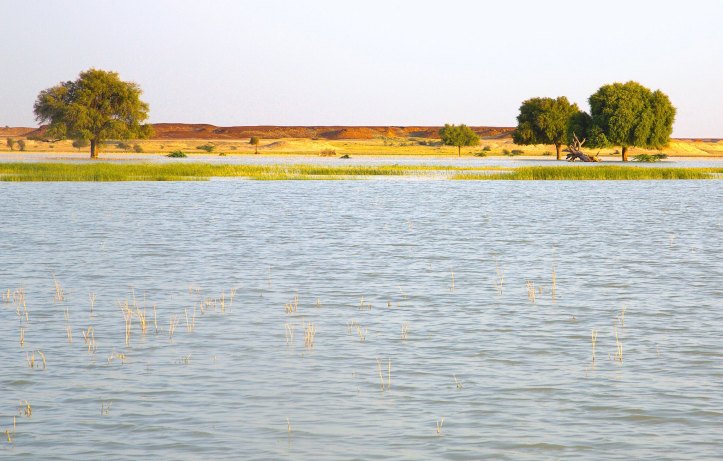
At first glance, a khadeen can look like a field.
It is much more than that.
A khadeen is a rainwater harvesting system, an agricultural landscape, and in many ways a philosophy. Built across natural runoff paths, earthen embankments hold seasonal water long enough for moisture to seep into the soil. After the water recedes, crops are grown on that stored moisture.
Farming after water has left.
That idea stayed with me.
In a place where conventional agriculture should have been impossible, people designed abundance through observation.
Rain arriving from distant catchments brings not just water but silt, nutrients and organic matter. The khadeen captures all of it.
No pumps.
No fertilizer.
Very little intervention.
Just hydrology understood over generations.
Some khadeens stretch for kilometres. Some work in linked chains, one overflowing into another. Many built centuries ago still produce harvest.
And they do more than grow grain.
They support livestock.
They recharge soils.
They create resilience.
In the film, one farmer called khadeens “the eternal field of life and wealth.” It did not feel poetic. It felt precise.
Because in these landscapes, wealth was never only money.
It was crops.
Animals.
Community.
And water held long enough for life to continue.
Khadeens are often described as ancient water systems.
I increasingly think of them as living intelligence.
Tanosar Khadeen after monsoon.