In Rajasthan, ponds are rarely just ponds.
They are memory, infrastructure and public commons.
I came to understand that while filming Biprasar, Jaseri, Gadsisar and other water bodies. Each had a different scale, history and design. Yet all carried the same principle.
Catch every drop.
Use it well.
Protect it together.
There is a saying in the desert that even 10 millimetres of rain can begin a water story.
Less rain may fill a small toba.
More may fill village ponds.
A stronger monsoon fills lakes and linked systems.
Nothing is wasted.
What struck me most was the sophistication hidden in what looks simple.
Catchments were shaped with slopes.
Water movement was anticipated.
Overflow was designed.
Some lakes even used carved stone markers to indicate water levels to the whole town.
Hydrology was public knowledge.
And ponds were social works.
Built by villagers, pastoralists, sometimes kings, often all together.
Biprasar still supports many villages.
Jaseri is called Jalapoorna — Goddess of Water.
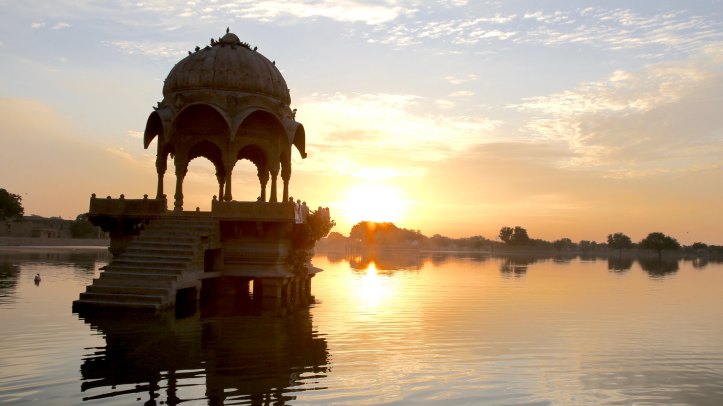
Gadsisar is remembered not just for its engineering, but for the ruler who joined the digging himself.
These were not isolated structures.
They were systems society organized around.
Today many have declined. Catchments are broken. Urban growth has severed links between ponds.
But in villages, I still saw attachment.
People speak of ponds almost as living relations.
That may be the deeper lesson.
Water survived here not only because of engineering.
But because it was held in culture.
A pond, in Rajasthan, was never just storage.
It was civilisation arranged around rain.
 amittiwari.org